

Semana Santa in Laratuka:
Five Centuries of Living Faith and Tradition

Semana Santa, or "Holy Week" in Portuguese, is the final week before Easter, a sacred time for Catholics to reflect on the suffering, death, and resurrection of Jesus Christ. In Indonesia this celebration is most famously observed in Laratuka, a small town in East Flores, East Nusa Tenggara.
The Semana Santa tradition in Laratuka was introduced by the Portuguese in the 16th century and has been preserved for over five centuries. Over time, it has evolved into a unique blend of Portuguese heritage and local Lamaholot wisdom, creating a deeply spiritual, sacred, and meaningful experience.

Larantuka is known as the "City of Reinha", derived from the Portuguese word Reinha meaning "Queen", referring to the Virgin Mary as the protector of the city. During Semana Santa, the town is filled with religious activities honoring Mary, transforming Larantuka into a center of pilgrimage and devotion, attracting thousands of pilgrims from Flores, across East Nusa Tenggara, and even from abroad.
Symbolism and Language
Semana Santa in Laratuka is rich in symbols and terminology that combine Portuguese and local language:
-
Tuan Ma = The Virgin Mary: "Tuan" means "the revered one," and "Ma" means "Mother."
-
Tuan Ana = Jesus Christ: "Ana" means "Child."
-
Tuan Menino = The child Jesus: from the Portuguese "Menino", meaning "little child" or "baby," Symbolizing Jesus in His infancy.
Each statue is not merely an object, but a spiritual focal point serving as a bridge between the faithful and the Gospel narrative, as well as a living symbol of faith.
Sequence of Semana Santa Processions
A. Rabu Trewa: Meaningful Chaos

Wednesday evening before Maundy Thursday is known as Rabu Trewa. The word "Trewa" means noisy or chaotic. Young people create loud sounds by beating metal sheets and dragging cans, symbolizing the betrayal of Judas Iscariot and the turmoil of nature at the time of Jesus' arrest. After Rabu Trewa, the town enters a period of complete silence, marking the beginning of deep reflection and mourning leading up tp Easter.
B. Maundy Thursday: The Ritual of Cium Taun

Ritual Cium Taun (Tuan Ma: left, Tuan Ana: right)
After the Mass of the Last Supper, the chapels of Taun Ma and Tuan Ana are opened. Thousands of devotees come to perform the Cium Tuan ritual, kissing the feet of the statues as an expression of love, reverence, and personal prayer.
C. Good Friday: The Peak of Devotional Mourning
-
The Sea Procession of Tuan Meninu


The Sea Procession of Tuan Meninu (The image shows the Tuan Meninu boat along with the statue of Tuan Meninu being carried.)
The statue of Tuan Meninu is carried using a traditional boat (beru) from the Tuan Meninu chapel, crossing the sea towards Kuce Beach. After arriving at Kuce Beach, the statue is placed at a stopping point at the Armida in Kabun Sirih.
-
The Small Procession of Escorting the Statues of Tuan Ma and Tuan Ana


The statues of Tuan Ma and Tuan Ana are escorted to the Reinha Rosari Cathedral in Larantuka
The statue of Tuan Ma departs to welcome Tuan Ana to the Cathedral Church of Reinha Rosari. This procession is accompanied by prayers and hymns performed by the Konfreria, a religious brotherhood responsible for maintaing the sacredness of the statues
-
The Grand Procession on Good Friday Night


The Good Friday Night Procession, The statues of Tuan Ma and Tuan Ana are paraded around the City of Larantuka
The climax of Semana Santa unfolds in solemn silence. The statues of Tuan Ma and Tuan Ana are carried around the town, illuminated by candles placed along the Turo, a sacred bamboo fence.
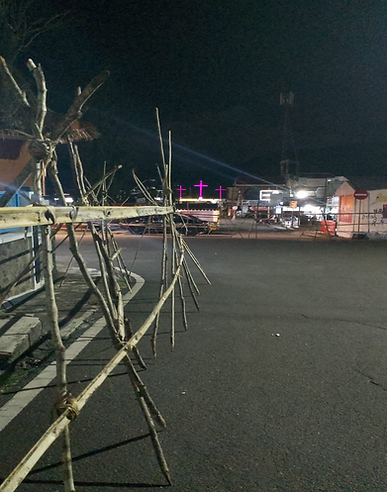
Turo is installed along the procession route both for the smaller and larger processions, during the day and at night. It serves as a sacred boundary, guiding the procession, marking the route, holding candles, and preserving the sanctity of the event
Turo, A wooden and bamboo fence that guides the procession, marks the route, and serves as a place for placing candles
The Mystery of Lakademu

Lakademu, The bearers of the statue of Tuan Ana
Specifically refers to the bearers of the Tuan Ana statue during the Grand Procession on Good Friday night. The bearers are selected one year in advance, and their identities remain confidential. They wear robes that fully cover their bodies, enhansing the sared and mysterious atmosphere. They carry the statue through each Armida while Ovos lamentation chants symbolie Christ's suffering are sung.
Armida and Ovos
Armida: There are wight stopping points, representing the eight clans of Larantuka
Ovos: Lamentation hymns are sung at each Armida, expressing deep sorrow over the suffering of Jesus.
D. Holy Saturday and Easter Sunday
Holy Saturday: Is a time of silence and waiting. The statues are returned to their places, homes
become spaces of prayer and candles are lit in preparation for the joy of Easter.
Easter Sunday: Marks the transformation of sorrow into joy, as the faithful celebrate the
resurrection of Jesus Christ, bringing the Semana Santa observations to a close.
The Role of Konfreria and Community Participation
The Konfreria Reinha Rosari: Serves as the heart of Semana Santa, safeguarding the statues, leading prayers, and ensuring the sacredness of the processions.
Local residents: Prepare candles, turo, street decorations, and open their homes as prayer points or resting places for pilgrims.
Young people: Actively participate in Rabu Trewa and the processions, ensuring the continuity of the tradition.
Thousands of pilgrims from Flores, across East Nusa Tenggara, and from abroad attend each year, making Laratuka a major center of pilgrimage and religious tourism.
Conclusion: A harmony of Faith, Culture, and Spirituality
Semana Santa is Larantuka is not merely an annual ritual, but a living journey of faith that
harmoniously blends history, culture and spirituality.
A Living Historical Heritage
This tradition carries the legacy of the 16th-century Portuguese presence, preserved in language, symbols and rituals. The statues of Tuan Ma and Tuan Ana, Tuan Meninu reflect a continuous connection between heritage and local spirituality.
Deep Symbolism
Turo, Armida, Ovos and the Mystery of Lakademu are merely visual elements, but are profound symbols of the human spiritual journey reflecting suffering, hope, and eventual joy.
Community Participation as the Core
The Konfreria and the local community play vital roles in preserving the sanctity of the tradition. Youth involvement, homes turned into prayer spaces, and the transformation of the town into a living sacred space highlight the communal essence of this celebration
A Universal Spiritual Experience
Semana Santa is not only for the local Catholic community, but also a spiritual magnet for international pilgrims, offering everyone the opportunity to experience the depth of faith and culture.
Lessons for the Present and the Future
This tradition teaches that faith is not merely spoken, but lived, nurtured and passed on through generations. Semana Santa demonstrates that harmony between history, culture, and spirituality can provide profound meaning in modern life.
Thus, Semana Santa in Larantuka stands as a powerful testiment to how tradition can endure,
unite communities, and remain relevant for over five centuries offering a religious experience that is profound, moving, and unforgettable.